Proposals that win: reuse without copy and paste

Nearly every proposal starts from another, which is how another client’s name or someone else’s figure slips in. Seven practices for reusing without copy and paste.
Nearly every consulting proposal starts from another proposal: you open the last one that looked similar, change the client’s name and adjust whatever stands out. It is quick, and it is the most reliable way to send a client someone else’s name, a figure from a different project or a scope nobody meant to promise. Reusing is fine. What fails is reusing by copy and paste.
Here are seven practices so that reusable material lives in one place and each proposal is written about the client in front of you.
1. Separate what doesn’t change from what does
Who you are, your methodology, your services and your case studies change little. The client’s diagnosis, scope, schedule and price always change. If everything lives in the same file, every new proposal drags the old one along. Split the proposal into two layers: base material that someone maintains, and a client-specific part written each time.
2. One current version of each piece
If you have three versions of “About us” in three folders, someone will use the wrong one. Pick one, give it an owner and retire the rest. Same for the methodology and the case studies: a case that is no longer representative comes out of the library; it is not kept “just in case”.
3. Prices come from a list, not from the last proposal
Last year’s proposal PDF is not a price list, even if everyone uses it as one. Keep a service catalogue with price and unit, and have quotes come from it. A copied price ages without warning; one that comes from the catalogue gets fixed in one place.
4. Start with the client’s problem, not with yourself
The proposal that wins usually opens with what the client said in the discovery meeting, in their own words, and only then presents the solution. For that you need notes from that meeting that can actually be searched. A discovery script with the same ten questions makes one client’s notes comparable with another’s.
5. Flag what is missing instead of filling it in
The worst thing about reuse is the plausible but foreign detail: a headcount, an industry, a deadline. Put visible markers (“[CONFIRM]”) wherever client information is missing, and check that none is left before sending. A proposal with an honest gap beats a complete one that is wrong.
6. Check against a short list before sending
- Does the client’s name appear correctly on every page, headers and footers included?
- Does the scope say what is and isn’t included?
- Does every figure have a source: catalogue, meeting or client data?
- Are assumptions written down (who delivers what, and when)?
- Do the case studies match a similar problem?
7. Learn from the losses
The library improves when it feeds on what you learned. If a proposal is lost on price, scope or lack of references, record it on the opportunity with a reason from a fixed catalogue, not free text. With a few months of data you will know which section of your base material needs rewriting.
How it looks in Iurefficient
In Iurefficient, the base material lives in Settings → Knowledge library: presentation, methodology, products and services, case studies and objection handling. It is what the assistant consults when drafting proposals and scripts.
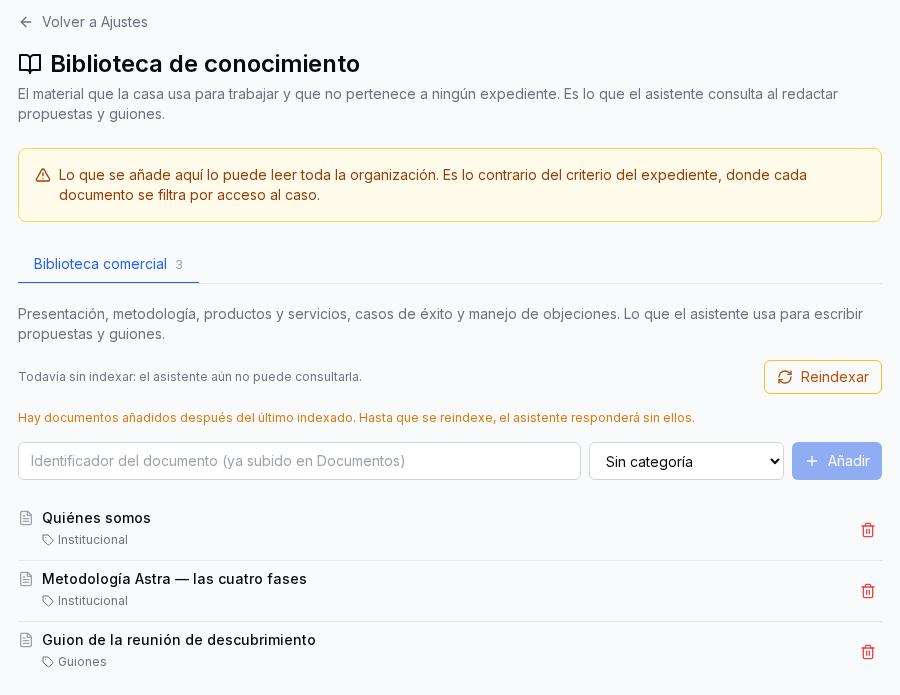
Three things worth knowing, which the screen itself points out: a document is added to the library without being copied (it is the same document, with its history); whatever goes in can be read by the whole organization, so it is no place for a client’s material; and you must press Reindex after adding, or the assistant will answer without the new material. Prices are not uploaded as documents: they come from the Billing service catalogue, the same list that feeds quotes and invoices.
And as the opportunity moves forward, the CRM keeps its path through the pipeline and requires a reason when it is marked as lost, which is the raw material for practice 7.
¿Quieres ver Iurefficient en acción?
Agenda una demostración o empieza tu prueba gratuita hoy mismo.
Solicitar demo